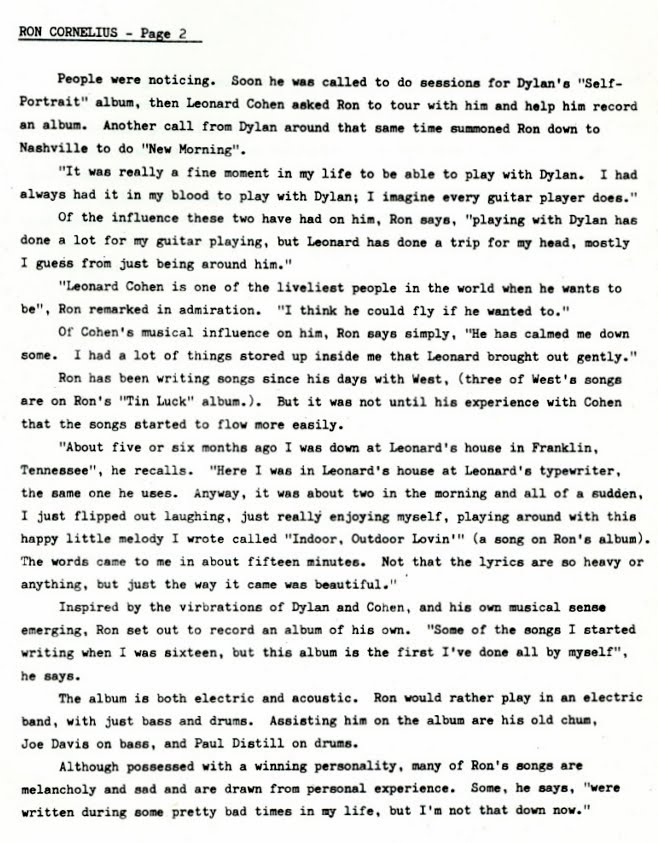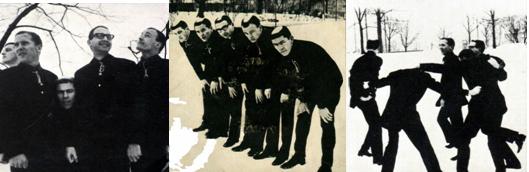
The story of The Monks is one of the strangest in rock history. Though they remained obscure for decades after their split in 1967, they are now regarded as clear precursors of punk and one of the pre-eminent cult bands of the 1960s. I won't rehash their story, which is readily available elsewhere, but I thought I'd share some rare odds and ends I have accumulated. First of all, here's the original press release sent out by Polydor International's German division to announce their album and debut single in April 1966. I am most grateful to Wolfgang Voelkel for the translation printed beneath it. [Wolfgang also told me: "I saw The Monks at Beat Club in 1966. I was sitting there hoping to see The Hollies or someone like that, and then came The Monks. I was really shocked. They were so terribly different."]


A few things strike me about this. Firstly, in its early days the band was called Monks, not The Monks - nowhere on their first two singles, album or promo material were they called anything other than plain Monks. Secondly, Polydor was clearly aware that they were unusual, and exploited their freak appeal in marketing them. Thirdly, the album is referred to as just Monks here, though it was released as Black Monk Time shortly afterwards. Fourthly, it's interesting that they intended to play in America only if they sold records in Germany: I am sure they were correct in assuming that unless they had a track record of success elsewhere, no one in the US would have touched them at the time. Finally, perhaps part of their uniqueness can be attributed to the fact that each member came from a different part of the US (they were of course thrown together as GIs in Germany): Minnesota, Texas, Chicago, Washington and California. I can't think of any contemporaneous US band with members from such different corners of their homeland - almost all bands worldwide in early 1966 came from one place.
Here are the artwork & labels for their first two 45s and the Black Monk Time LP. As you can perhaps make out, the label to side one of my LP (which once belonged to a radio station) has 13/6/66 written on it:


In the spring of 1966 Polydor also printed some promo postcards. Mine is signed on both sides to one Brigitte, evidently from Cologne:


On the back of the card the inscriptions read:
For Brigitte! The nicest girl in Koln! Love ya! Gary
To Brigitte, best wishes and I hope you come to see us whenever you can, Roger
Brigitte, you have black on your lip, Eddie
Thanks for coming with Liz to see us, best wishes, David Day
Beneath the scribble, the German text reads: 'Gary Burger plays lead guitar and was born in Minnesota Texas Chicago Washington California
The band played around Germany, appeared on radio and TV (check the amazing Beat Club footage on youtube) and had many adventures, as chronicled in Shaw's Black Monk Time book. Nonetheless, they didn't sell many records, and the age-old disagreements over musical direction led to their split in 1967 after the release of a final (and far less confrontational) 45 that April. Below is the picture sleeve (which is identical on both sides) and the relevant label from a Polydor radio promo LP of the time, also showcasing hot releases by Bert Kaempfert and others:


I assume that articles and reviews appeared in the German music press at the time, but I have never seen any. If anyone has any, please get in touch!